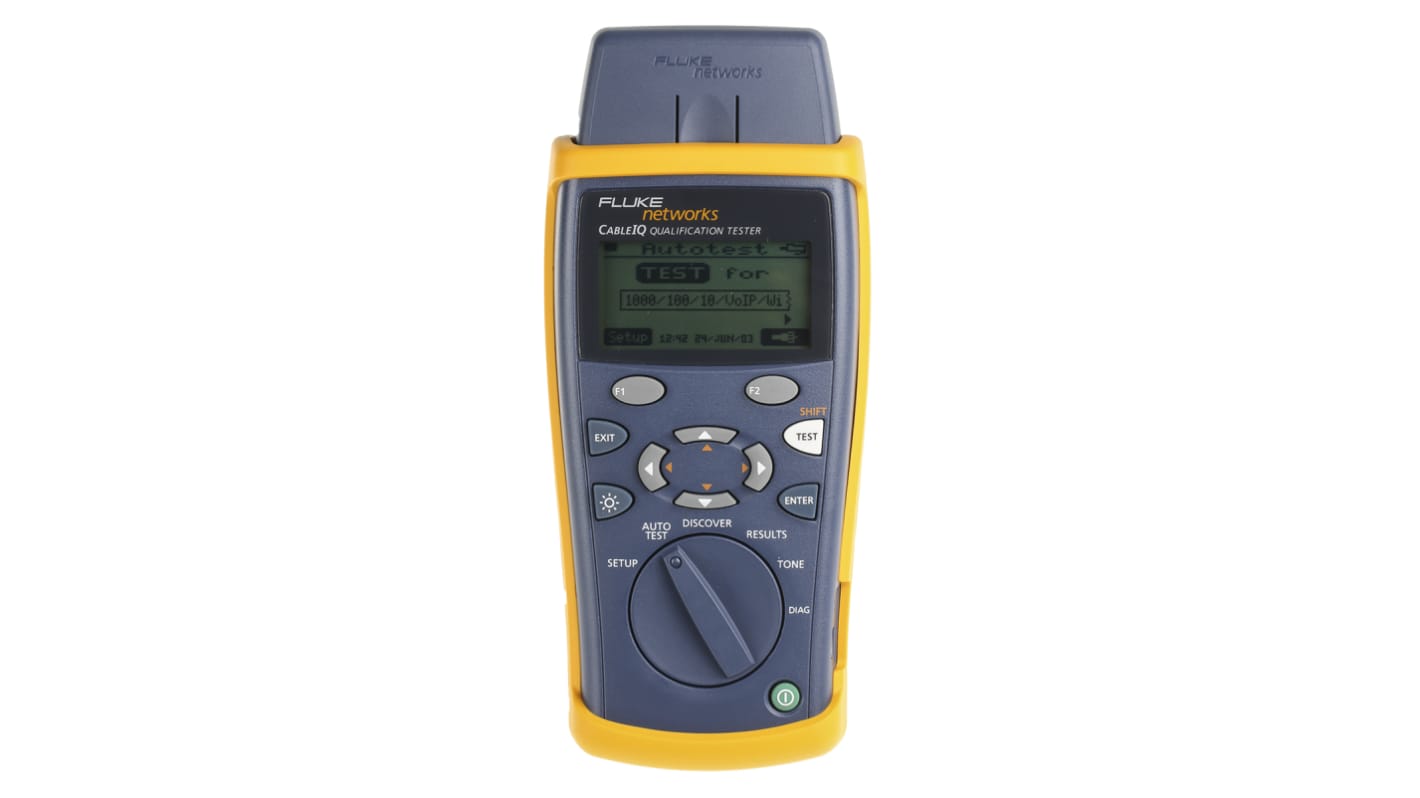
Fluke Networks CableIQ Cable Tester Coaxial
- N° de stock RS:
- 513-6435
- Référence fabricant:
- CIQ-100
- Fabricant:
- Fluke Networks

Actuellement indisponible
Nous ne savons pas si cet article sera de nouveau disponible. RS a l'intention de le retirer de son assortiment sous peu.
- N° de stock RS:
- 513-6435
- Référence fabricant:
- CIQ-100
- Fabricant:
- Fluke Networks
Spécifications
Documentation technique
Législations et de normes
Détails du produit
Recherchez des produits similaires en sélectionnant un ou plusieurs attributs.
Sélectionner tout | Attribut | Valeur |
|---|---|---|
| Marque | Fluke Networks | |
| Equipment Type | Cable Tester | |
| Connector Type | Coaxial | |
| Tone | Yes | |
| Model Number p | CableIQ | |
| Power Source | Battery | |
| Battery Type | AA | |
| Battery Life | 20 h | |
| Dimensions | 7 x 3.5 x 1.75in | |
| Weight | 550g | |
| Display Type | LCD | |
| Height | 45mm | |
| Length | 178mm | |
| Maximum Operating Temperature | +50°C | |
| Minimum Operating Temperature | -20°C | |
| Width | 89mm | |
| Sélectionner tout | ||
|---|---|---|
Marque Fluke Networks | ||
Equipment Type Cable Tester | ||
Connector Type Coaxial | ||
Tone Yes | ||
Model Number p CableIQ | ||
Power Source Battery | ||
Battery Type AA | ||
Battery Life 20 h | ||
Dimensions 7 x 3.5 x 1.75in | ||
Weight 550g | ||
Display Type LCD | ||
Height 45mm | ||
Length 178mm | ||
Maximum Operating Temperature +50°C | ||
Minimum Operating Temperature -20°C | ||
Width 89mm | ||
Statut RoHS non applicable
- Pays d'origine :
- CN
FLUKE Network Cable Tester, Coaxial Connectors, Battery Powered - CIQ-100
Finding it hard to pin down a fault on your Ethernet cable? Root it out with this CableIQ network cable tester from FLUKE. The versatile tool is ideal for troubleshooting voice, data and coax wiring and you don't need special skills to use it thanks to its simple operation. A built-in time domain reflectometer graphically shows you the distance to a fault, making problem areas a cinch to find. As it identifies breaks and shorts by pin, it quickly guides you to a snapped wire or faulty terminated jack. This tester's also got you covered if you need to print out professional reports, as software is integrated into the design.
Features & Benefits
• Large graphical display for quick and simple diagnostics
• Easy-to-use dial interface offers convenient mode-switching
• Storage capacity of up to 250 results to keep data on hand
• Battery-operated for mobility and ease of use
• Easy-to-use dial interface offers convenient mode-switching
• Storage capacity of up to 250 results to keep data on hand
• Battery-operated for mobility and ease of use
Applications
• IT professionals
• Data and communication centres
• Electrical engineering
• Retail outlets
• Data and communication centres
• Electrical engineering
• Retail outlets
Does this network cable tester identify crosstalk?
Yes, besides its standard functions, you can also use this versatile tool for advanced troubleshooting, such as diagnosing crosstalk, noise interference and insertion loss.