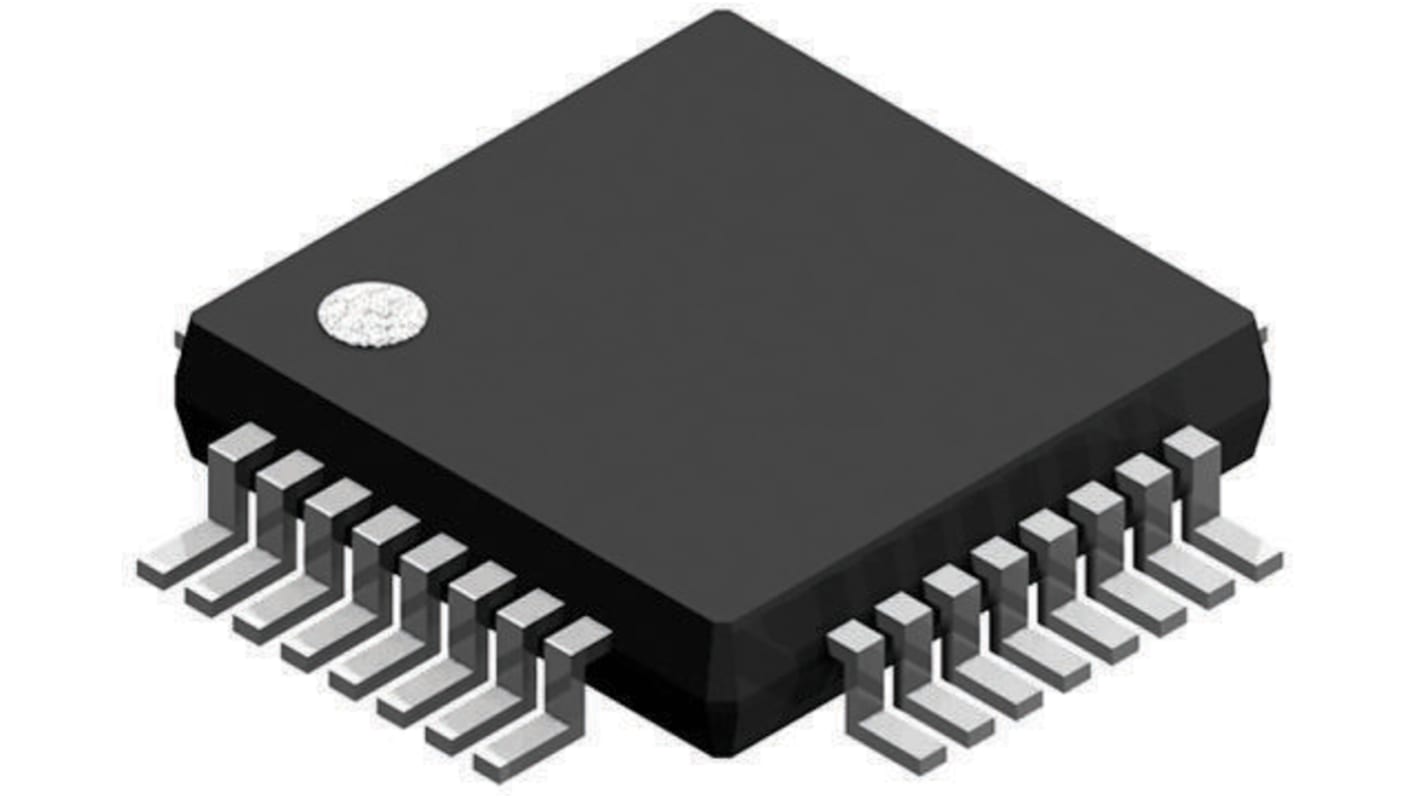
Silicon Labs, 8bit CIP-51, EFM8UB Microcontroller, 48MHz, 32 kB Flash, 32-Pin QFP
- N° de stock RS:
- 865-6345
- Référence fabricant:
- EFM8UB20F32G-A-QFP32
- Fabricant:
- Silicon Labs

Indisponible
RS n'aura plus ce produit en stock.
- N° de stock RS:
- 865-6345
- Référence fabricant:
- EFM8UB20F32G-A-QFP32
- Fabricant:
- Silicon Labs
Spécifications
Documentation technique
Législations et de normes
Détails du produit
Recherchez des produits similaires en sélectionnant un ou plusieurs attributs.
Sélectionner tout | Attribut | Valeur |
|---|---|---|
| Marque | Silicon Labs | |
| Family Name | EFM8UB | |
| Package Type | QFP | |
| Mounting Type | Surface Mount | |
| Pin Count | 32 | |
| Device Core | CIP-51 | |
| Data Bus Width | 8bit | |
| Program Memory Size | 32 kB | |
| Maximum Frequency | 48MHz | |
| RAM Size | 2.304 kB | |
| USB Channels | 1 | |
| Number of SPI Channels | 1 | |
| Number of USART Channels | 0 | |
| Typical Operating Supply Voltage | 3.3 V | |
| Number of UART Channels | 2 | |
| Number of I2C Channels | 2 | |
| Number of CAN Channels | 0 | |
| Program Memory Type | Flash | |
| Number of PCI Channels | 0 | |
| Number of Ethernet Channels | 0 | |
| Length | 7mm | |
| ADCs | 1 (20 x 10 bit) | |
| Maximum Number of Ethernet Channels | 0 | |
| Instruction Set Architecture | MCU | |
| Minimum Operating Temperature | -40 °C | |
| Number of ADC Units | 1 | |
| Width | 7mm | |
| Dimensions | 7 x 7 x 1.45mm | |
| Pulse Width Modulation | 1 | |
| Number of LIN Channels | 0 | |
| Maximum Operating Temperature | +85 °C | |
| Height | 1.45mm | |
| Sélectionner tout | ||
|---|---|---|
Marque Silicon Labs | ||
Family Name EFM8UB | ||
Package Type QFP | ||
Mounting Type Surface Mount | ||
Pin Count 32 | ||
Device Core CIP-51 | ||
Data Bus Width 8bit | ||
Program Memory Size 32 kB | ||
Maximum Frequency 48MHz | ||
RAM Size 2.304 kB | ||
USB Channels 1 | ||
Number of SPI Channels 1 | ||
Number of USART Channels 0 | ||
Typical Operating Supply Voltage 3.3 V | ||
Number of UART Channels 2 | ||
Number of I2C Channels 2 | ||
Number of CAN Channels 0 | ||
Program Memory Type Flash | ||
Number of PCI Channels 0 | ||
Number of Ethernet Channels 0 | ||
Length 7mm | ||
ADCs 1 (20 x 10 bit) | ||
Maximum Number of Ethernet Channels 0 | ||
Instruction Set Architecture MCU | ||
Minimum Operating Temperature -40 °C | ||
Number of ADC Units 1 | ||
Width 7mm | ||
Dimensions 7 x 7 x 1.45mm | ||
Pulse Width Modulation 1 | ||
Number of LIN Channels 0 | ||
Maximum Operating Temperature +85 °C | ||
Height 1.45mm | ||
EFM8UB Universal Bee Microcontrollers, Silicon Labs
The Universal Bee Microcontroller (MCU) family are designed for USB applications. Operating at up 50 MHz with a pipelined 8-bit C8051 core.
Up to 22 multifunction, 5 V tolerant I/O pins
Low energy USB support
Priority crossbar for flexible pin mapping
12-bit Analogue to Digital converter (ADC)and 2 analogue comparators with internal voltage DAC as reference input
5 16-bit timers
Integrated temperature sensor
2 UARTs, SPI and SMBus/I2C master/slave and I2C slave
Low energy USB support
Priority crossbar for flexible pin mapping
12-bit Analogue to Digital converter (ADC)and 2 analogue comparators with internal voltage DAC as reference input
5 16-bit timers
Integrated temperature sensor
2 UARTs, SPI and SMBus/I2C master/slave and I2C slave
The EFM8 8-bit microcontroller family has an unparalleled combination of features and capabilities including a high-speed pipelined 8051 core, ultra-low power, precision analogue and enhanced communication peripherals, integrated oscillators, small-footprint packages, and a crossbar architecture that enables flexible digital and analogue multiplexing to simplify PCB design and I/O signal routing. These next-generation 8-bit devices are aimed at the engineer developing products for the Internet-of-Things (IoT) which will be very small, perform complex processing and run off tiny batteries.