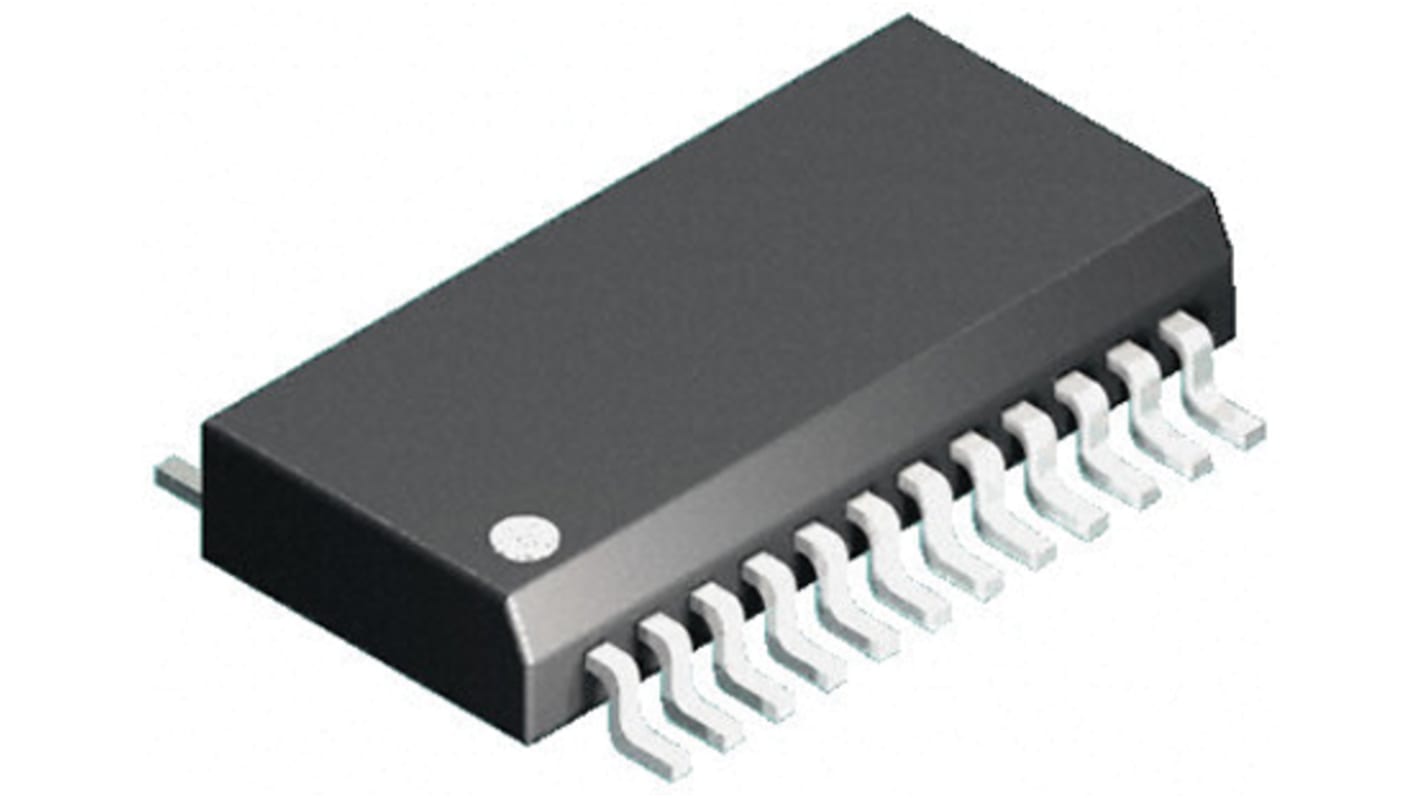
Silicon Labs, 8bit CIP-51, EFM8SB Microcontroller, 25MHz, 8 kB Flash, 24-Pin QSOP
- N° de stock RS:
- 865-6308
- Référence fabricant:
- EFM8SB10F8G-A-QSOP24
- Fabricant:
- Silicon Labs

Indisponible
RS n'aura plus ce produit en stock.
- N° de stock RS:
- 865-6308
- Référence fabricant:
- EFM8SB10F8G-A-QSOP24
- Fabricant:
- Silicon Labs
Spécifications
Documentation technique
Législations et de normes
Détails du produit
Recherchez des produits similaires en sélectionnant un ou plusieurs attributs.
Sélectionner tout | Attribut | Valeur |
|---|---|---|
| Marque | Silicon Labs | |
| Family Name | EFM8SB | |
| Package Type | QSOP | |
| Mounting Type | Surface Mount | |
| Pin Count | 24 | |
| Device Core | CIP-51 | |
| Data Bus Width | 8bit | |
| Program Memory Size | 8 kB | |
| Maximum Frequency | 25MHz | |
| RAM Size | 512 B | |
| USB Channels | 0 | |
| Number of SPI Channels | 1 | |
| Number of USART Channels | 0 | |
| Number of I2C Channels | 1 | |
| Number of CAN Channels | 0 | |
| Number of UART Channels | 1 | |
| Typical Operating Supply Voltage | 2.4 V | |
| Program Memory Type | Flash | |
| Number of PCI Channels | 0 | |
| Number of Ethernet Channels | 0 | |
| Number of LIN Channels | 0 | |
| Height | 1.5mm | |
| Width | 3.9mm | |
| Dimensions | 8.65 x 3.9 x 1.5mm | |
| Pulse Width Modulation | 1 | |
| Length | 8.65mm | |
| ADCs | 10 x 12 bit | |
| Maximum Number of Ethernet Channels | 0 | |
| Instruction Set Architecture | MCU | |
| Minimum Operating Temperature | -40 °C | |
| Maximum Operating Temperature | +85 °C | |
| Number of ADC Units | 1 | |
| Sélectionner tout | ||
|---|---|---|
Marque Silicon Labs | ||
Family Name EFM8SB | ||
Package Type QSOP | ||
Mounting Type Surface Mount | ||
Pin Count 24 | ||
Device Core CIP-51 | ||
Data Bus Width 8bit | ||
Program Memory Size 8 kB | ||
Maximum Frequency 25MHz | ||
RAM Size 512 B | ||
USB Channels 0 | ||
Number of SPI Channels 1 | ||
Number of USART Channels 0 | ||
Number of I2C Channels 1 | ||
Number of CAN Channels 0 | ||
Number of UART Channels 1 | ||
Typical Operating Supply Voltage 2.4 V | ||
Program Memory Type Flash | ||
Number of PCI Channels 0 | ||
Number of Ethernet Channels 0 | ||
Number of LIN Channels 0 | ||
Height 1.5mm | ||
Width 3.9mm | ||
Dimensions 8.65 x 3.9 x 1.5mm | ||
Pulse Width Modulation 1 | ||
Length 8.65mm | ||
ADCs 10 x 12 bit | ||
Maximum Number of Ethernet Channels 0 | ||
Instruction Set Architecture MCU | ||
Minimum Operating Temperature -40 °C | ||
Maximum Operating Temperature +85 °C | ||
Number of ADC Units 1 | ||
EFM8SB Sleepy Bee Microcontrollers, Silicon Labs
The Sleepy Bee Microcontroller (MCU) family are deigned for low power and battery powered systems. Operating at up to 25 MHz with short wakeup times and low power consumption in both active and sleep modes.
8051 MCU core
Integrated temperature sensor
Integrated LDO maintains low active current at all voltages
Up to 14 capacitive sense channels
UART and I2C
4 16-bit timers
Integrated temperature sensor
Integrated LDO maintains low active current at all voltages
Up to 14 capacitive sense channels
UART and I2C
4 16-bit timers
The EFM8 8-bit microcontroller family has an unparalleled combination of features and capabilities including a high-speed pipelined 8051 core, ultra-low power, precision analogue and enhanced communication peripherals, integrated oscillators, small-footprint packages, and a crossbar architecture that enables flexible digital and analogue multiplexing to simplify PCB design and I/O signal routing. These next-generation 8-bit devices are aimed at the engineer developing products for the Internet-of-Things (IoT) which will be very small, perform complex processing and run off tiny batteries.