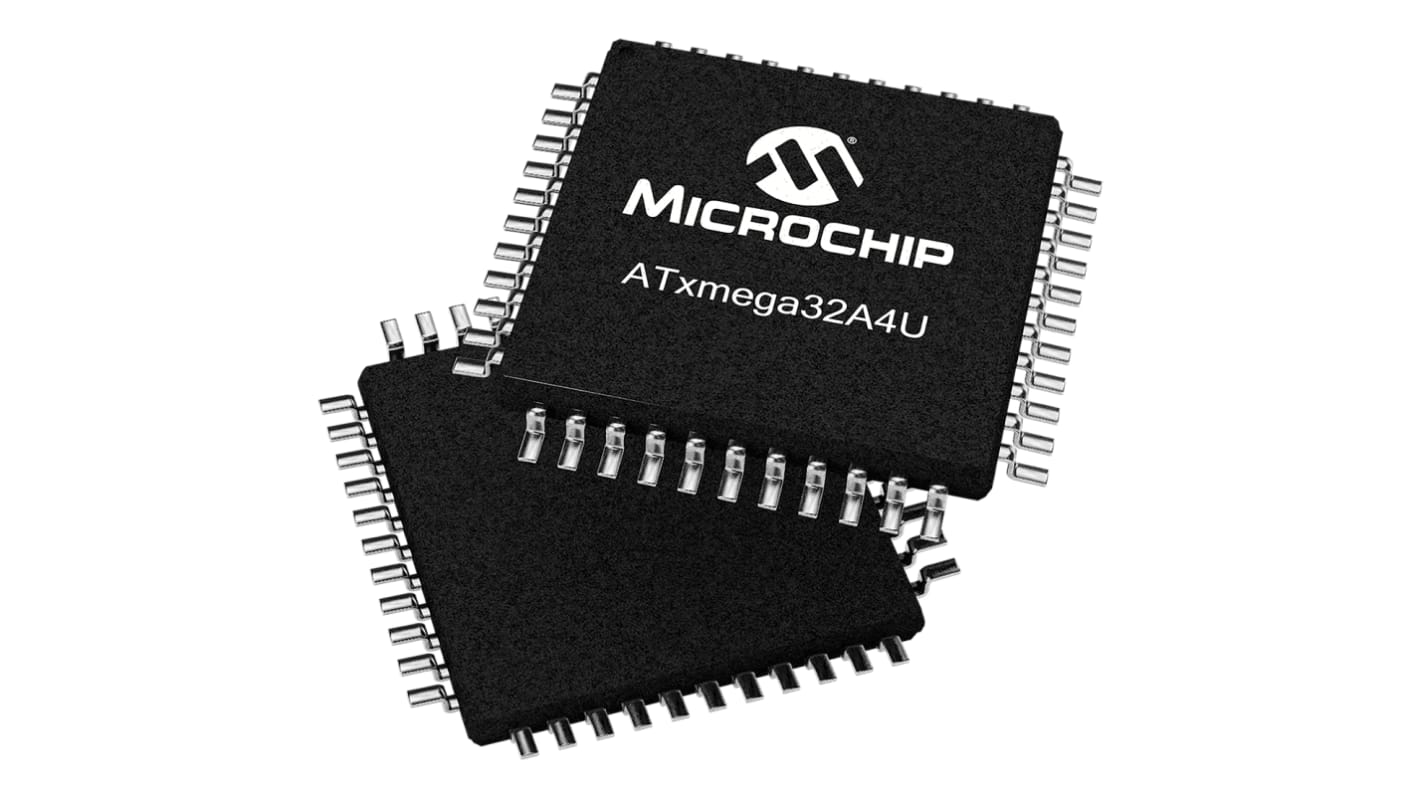
Microchip ATXMEGA32A4U-AU, 16 bit AVR, ATxmega32A4U Microcontroller, 32 MHz, 32kB FLASH, 44-Pin TQFP
- N° de stock RS:
- 133-1725P
- Référence fabricant:
- ATXMEGA32A4U-AU
- Fabricant:
- Microchip

Offre groupée disponible
Consulter les options de prix de grosSous-total 10 unités (conditionné en plateau)*
31,00 €
(TVA exclue)
37,50 €
(TVA incluse)
Frais de livraison offerts pour toute commande de plus de 90,00 €
En stock
- 818 unité(s) prête(s) à être expédiée(s) d'un autre centre de distribution
Besoin de plus? Cliquez sur " Vérifier les dates de livraison " pour plus de détails
Unité | Prix par unité |
|---|---|
| 10 - 22 | 3,10 € |
| 24 - 98 | 3,02 € |
| 100 + | 2,945 € |
*Prix donné à titre indicatif
- N° de stock RS:
- 133-1725P
- Référence fabricant:
- ATXMEGA32A4U-AU
- Fabricant:
- Microchip
Spécifications
Documentation technique
Législations et de normes
Détails du produit
Recherchez des produits similaires en sélectionnant un ou plusieurs attributs.
Sélectionner tout | Attribut | Valeur |
|---|---|---|
| Marque | Microchip | |
| Product Type | Microcontroller | |
| Series | ATxmega32A4U | |
| Package Type | TQFP | |
| Mount Type | Surface | |
| Pin Count | 44 | |
| Device Core | AVR | |
| Data Bus Width | 16bit | |
| Program Memory Size | 32kB | |
| Interface Type | SPI, PDI, USART, TWI | |
| Maximum Clock Frequency | 32MHz | |
| RAM Size | 4kB | |
| Maximum Supply Voltage | 3.6V | |
| Number of Programmable I/Os | 34 | |
| Minimum Operating Temperature | -40°C | |
| Analogue Comparators | 2 | |
| Maximum Operating Temperature | 85°C | |
| Standards/Approvals | No | |
| Height | 1.05mm | |
| Width | 10.1mm | |
| Length | 10.1mm | |
| Minimum Supply Voltage | 1.6V | |
| Number of Timers | 5 | |
| Instruction Set Architecture | RISC | |
| Program Memory Type | FLASH | |
| ADCs | 11 x 12 Bit | |
| Automotive Standard | No | |
| Sélectionner tout | ||
|---|---|---|
Marque Microchip | ||
Product Type Microcontroller | ||
Series ATxmega32A4U | ||
Package Type TQFP | ||
Mount Type Surface | ||
Pin Count 44 | ||
Device Core AVR | ||
Data Bus Width 16bit | ||
Program Memory Size 32kB | ||
Interface Type SPI, PDI, USART, TWI | ||
Maximum Clock Frequency 32MHz | ||
RAM Size 4kB | ||
Maximum Supply Voltage 3.6V | ||
Number of Programmable I/Os 34 | ||
Minimum Operating Temperature -40°C | ||
Analogue Comparators 2 | ||
Maximum Operating Temperature 85°C | ||
Standards/Approvals No | ||
Height 1.05mm | ||
Width 10.1mm | ||
Length 10.1mm | ||
Minimum Supply Voltage 1.6V | ||
Number of Timers 5 | ||
Instruction Set Architecture RISC | ||
Program Memory Type FLASH | ||
ADCs 11 x 12 Bit | ||
Automotive Standard No | ||
8/16-Bit AVR XMEGA Microcontrollers
Atmel AVR XMEGA microcontrollers deliver the best possible combination of real-time performance, high integration and low power consumption for 8/16-bit MCU applications.
Atmel AVR XMEGA devices employ advanced analogue-to-digital converters (ADCs) that deliver both high speed and high resolution. These ADCs offer up to four conversion channels with different result registers, which can have different setup and configuration processes. This provides easier use since different software modules can access and use an ADC independently.
The Event System facilitates inter-peripheral signaling for short and 100% predictable response time. This ensures real-time control, and also offloads the CPU because each time an event is used, one interrupt with context switch is eliminated. Most of the peripherals and the DMA controller are connected to the Event System. The AVR XMEGA E series features an asynchronous peripheral Event System instead.
The AVR XMEGA 4-channel direct memory access (DMA) controller can be used for fast, CPU-independent data transfer between any combination of data memory and peripherals.
AVR XMEGA devices use the Atmel AVR CPU. The instruction set and design of the CPU are tuned to minimize code size and maximize execution speed. Its true single-cycle execution of arithmetic and logic operations means AVR XMEGA microcontrollers perform close to 1MIPS per MHz. The fast-access register file with 32 x 8-bit general-purpose working registers is directly connected to the arithmetic logic unit (ALU). During a single clock cycle, the ALU can be fed two arbitrary registers, do a requested operation, and write back the result. It provides efficient support for 8-, 16- and 32-bit arithmetic.
Liens connexes
- Coral G950-06809-01 for use with Raspberry Pi
- Siemens SIMATIC S7-1200 Series PLC CPU for Use with SIMATIC S7-1200 Series Transistor Output 2
- Carling Technologies Illuminated DPDT, On-(On) Rocker Switch Panel Mount
- SICK Encoder Collets for Use with DBS36E-BBxxxx
- Littelfuse Through Hole Gas Discharge Tube
- Igus GFM-0607-08 6mm Bore Plain Bearing, 7mm O.D
- Raspberry Pi QWERTY (Spain) Raspberry Pi Keyboard
- Coral Google Mini PCIe M.2 Accelerator B/M Development Kit G650-04686-01