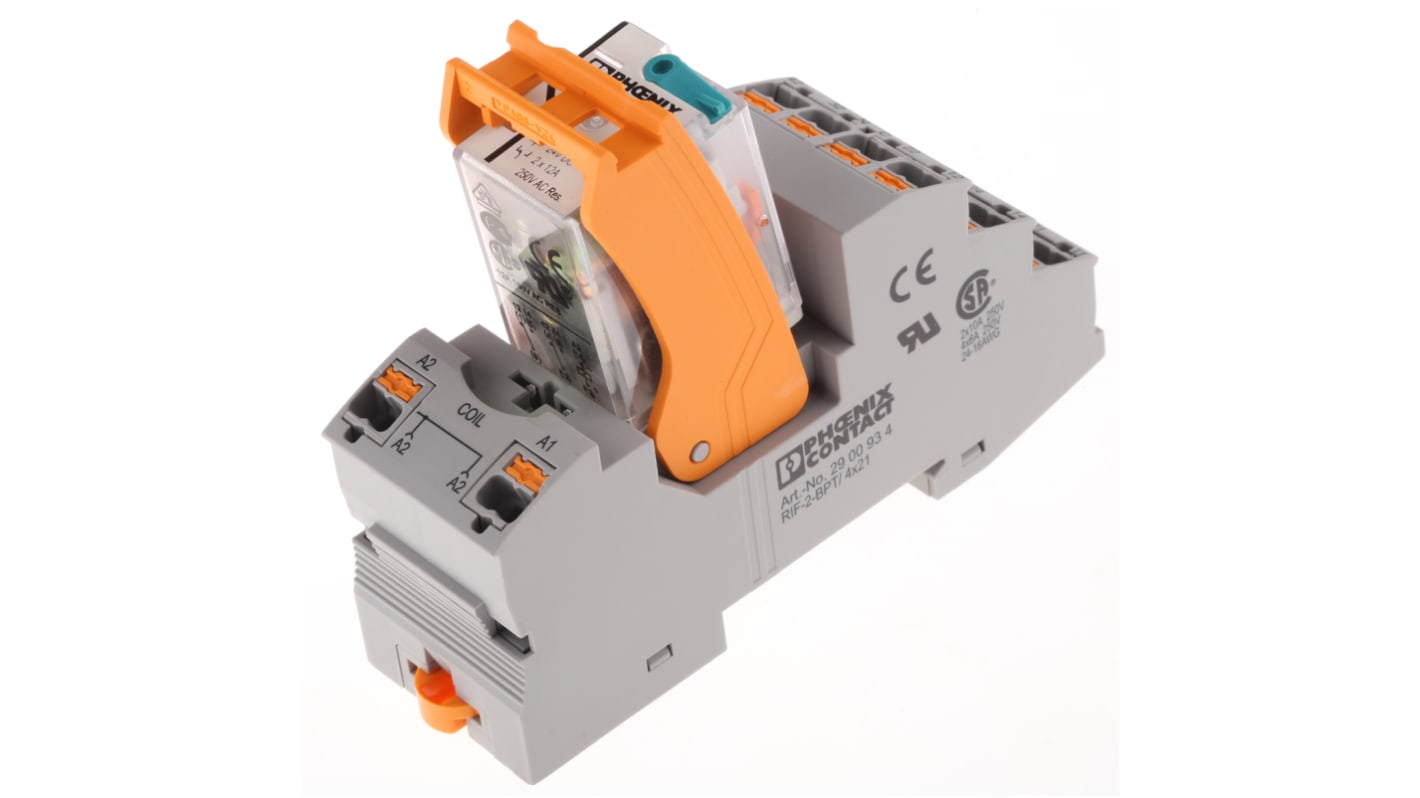
Phoenix Contact DIN Rail Interface Relay, 24V dc Coil, 5mA Switching Current, DPDT
- N° de stock RS:
- 794-3702
- Référence fabricant:
- 2903315
- Fabricant:
- Phoenix Contact

Offre groupée disponible
Consulter les options de prix de grosSous-total (1 unité)*
10,57 €
(TVA exclue)
12,79 €
(TVA incluse)
Frais de livraison offerts pour toute commande de plus de 90,00 €
En stock
- 31 unité(s) prête(s) à être expédiée(s) d'un autre centre de distribution
- Plus 40 unité(s) expédiée(s) à partir du 20 août 2026
Besoin de plus? Cliquez sur " Vérifier les dates de livraison " pour plus de détails
Unité | Prix par unité |
|---|---|
| 1 - 4 | 10,57 € |
| 5 - 9 | 10,25 € |
| 10 + | 9,93 € |
*Prix donné à titre indicatif
- N° de stock RS:
- 794-3702
- Référence fabricant:
- 2903315
- Fabricant:
- Phoenix Contact
Spécifications
Documentation technique
Législations et de normes
Détails du produit
Recherchez des produits similaires en sélectionnant un ou plusieurs attributs.
Sélectionner tout | Attribut | Valeur |
|---|---|---|
| Marque | Phoenix Contact | |
| Product Type | Interface Relay | |
| Coil Voltage | 24V dc | |
| Contact Configuration | DPDT | |
| Mount Type | DIN Rail | |
| Series | RIF | |
| Terminal Type | Plug-In | |
| Switching Current | 5mA | |
| Width | 75mm | |
| Standards/Approvals | EAC, CSA | |
| Height | 96mm | |
| Length | 31mm | |
| Sélectionner tout | ||
|---|---|---|
Marque Phoenix Contact | ||
Product Type Interface Relay | ||
Coil Voltage 24V dc | ||
Contact Configuration DPDT | ||
Mount Type DIN Rail | ||
Series RIF | ||
Terminal Type Plug-In | ||
Switching Current 5mA | ||
Width 75mm | ||
Standards/Approvals EAC, CSA | ||
Height 96mm | ||
Length 31mm | ||
- Pays d'origine :
- CN
Phoenix Contact Non-Latching Relay Module, DPDT - RIF-2-RPT-LDP-24DC/2X21- 2903315
Use this relay from Phoenix Contact to control four outputs from one switch. The DPDT (double pole, double throw) configuration means each of the two poles can switch between two contacts – one normally open and one normally closed. That means with a flick of a switch, you can power one operation while shutting off another on each of the two circuits. As this is a non-latching relay, the contacts return to their original positions when power is removed.
In addition to powering multiple devices, these relays are useful for standby modes, redundant signalling operations or changing the direction of a motor. The relay contains a damping diode to protect against voltage spikes, as well as a yellow LED (light-emitting diode) operating voltage display. Its contacts are silver alloy, which increases durability and reduces the transfer of material when the contacts close. Push-in connection makes the installation of this pre-assembled relay module simple.
• Coil voltage of 24 V DC
• Coil power of 77 mW
• Coil resistance of 640 Ω
• Mechanical service life of 20,000,000 cycles
• Maximum switching voltage of 250 V AC/DC
• Operating temperature range of -40°C to +60°C
• DIN rail mounting type
• Switching current of 2 A
Phoenix Contact Non-Latching Relays - RIF2 Power Relay Module Series
Phoenix contacts series of RIF2 power relay modules come pre-assembled with a push connection. They are considered to be electrical and mechanical devices. This type of relay can often be referred to as an electromechanical relay or an industrial switch. This RIF2 professional range is supplied with a base suppressor and retaining bracket that benefits from a universal plug-in design.
Features & Benefits
• Robust and hard-wearing
• Easy wiring because of the Advanced push-in connection technology
• Easy handling and extension of range
• Includes a plug-in display/suppressor module
• AC and DC versions available
• 2 or/and 4 contact options
• Yellow LED indicator
• Varistor or damping diode protective circuit
• The relay retaining bracket that is included is complete with ejector function and holder for marking material
What is a non-latching relay and how do they work?
A relay is an electrical switch that is operated by electrical pulses, their primary function is to open and close a circuit. When power passes through a circuit, a relay switches position (usually from NC to NO) using an internal Coil which generates a magnetic force. This force then holds the relay in a NO position, when the current is switched off the relay returns to the NC position. This function is what makes these non-latching relays perfect for push-button applications such as keyboards and micro-controller input buttons.
A little more info
Non-latching relays support a range of signal characteristics, ranging from low voltage or current to high voltage or current and from DC to GHz frequencies.
What is the difference between a latching relay and a non-latching relay?
When a latching relay operates its contacts, the relay holds its position, even when the supply of its operating Coil has been disconnected. When a non-latching relay operates its contacts, the relay will reset automatically once the supply of its Coil is disconnected through the internal spring mechanism.
Liens connexes
- Coral G950-06809-01 for use with Raspberry Pi
- Siemens SIMATIC S7-1200 Series PLC CPU for Use with SIMATIC S7-1200 Series Transistor Output 2
- Carling Technologies Illuminated DPDT, On-(On) Rocker Switch Panel Mount
- SICK Encoder Collets for Use with DBS36E-BBxxxx
- Littelfuse Through Hole Gas Discharge Tube
- Igus GFM-0607-08 6mm Bore Plain Bearing, 7mm O.D
- Raspberry Pi QWERTY (Spain) Raspberry Pi Keyboard
- Coral Google Mini PCIe M.2 Accelerator B/M Development Kit G650-04686-01