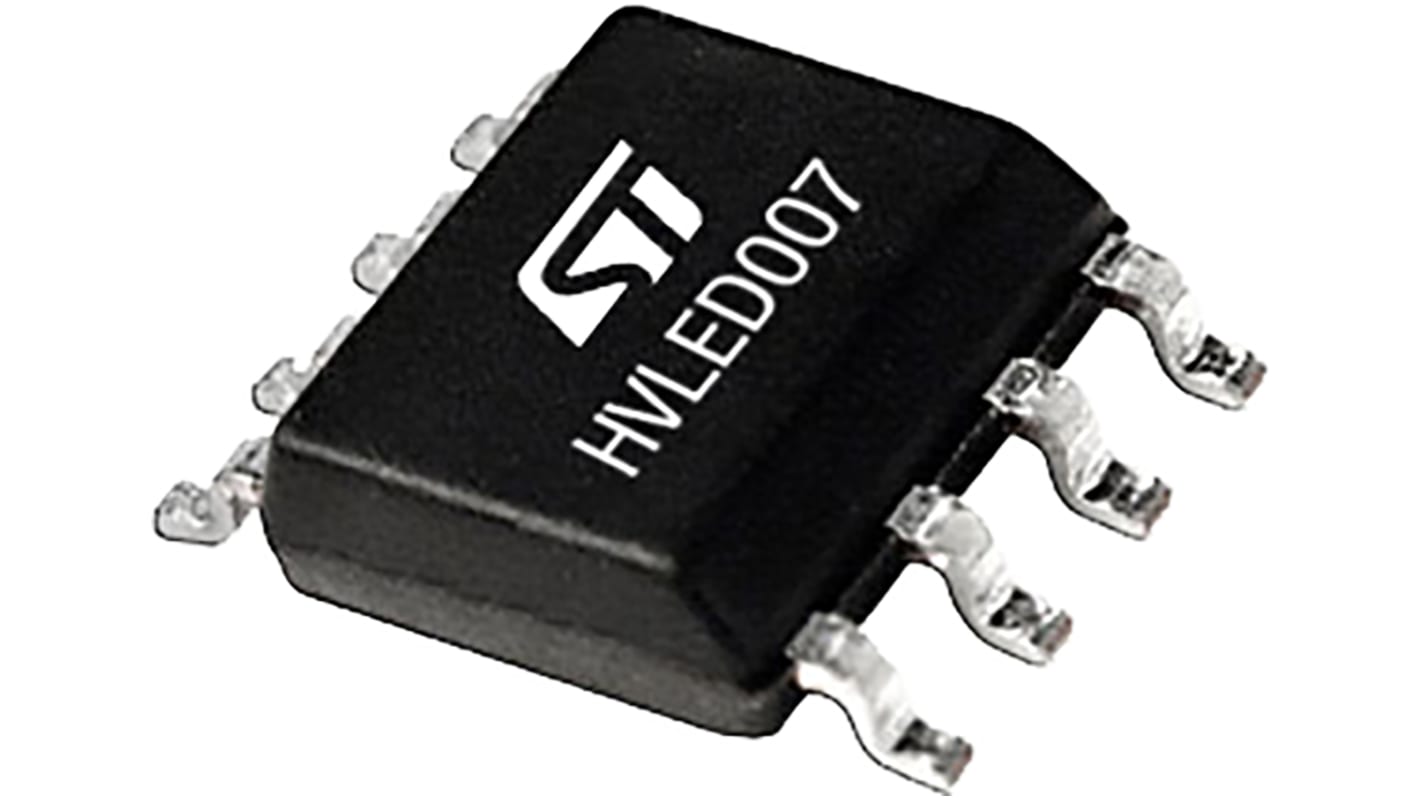
STMicroelectronics LED Driver, 100 W Output, 5.5 mA
- N° de stock RS:
- 193-9807
- Référence fabricant:
- HVLED007TR
- Fabricant:
- STMicroelectronics

Offre groupée disponible
Sous-total (1 paquet de 10 unités)*
8,87 €
(TVA exclue)
10,73 €
(TVA incluse)
Frais de livraison offerts pour toute commande de plus de 75,00 €
Temporairement en rupture de stock
- Expédition à partir du 11 août 2026
Besoin de plus? Cliquez sur " Vérifier les dates de livraison " pour plus de détails
Unité | Prix par unité | le paquet* |
|---|---|---|
| 10 - 40 | 0,887 € | 8,87 € |
| 50 - 90 | 0,862 € | 8,62 € |
| 100 - 240 | 0,839 € | 8,39 € |
| 250 - 490 | 0,818 € | 8,18 € |
| 500 + | 0,797 € | 7,97 € |
*Prix donné à titre indicatif
- N° de stock RS:
- 193-9807
- Référence fabricant:
- HVLED007TR
- Fabricant:
- STMicroelectronics
Spécifications
Documentation technique
Législations et de normes
Détails du produit
Recherchez des produits similaires en sélectionnant un ou plusieurs attributs.
Sélectionner tout | Attribut | Valeur |
|---|---|---|
| Marque | STMicroelectronics | |
| Product Type | Display Driver | |
| Maximum Output Power | 100W | |
| Input Voltage | 10.5 to 22.5 V | |
| Mount Type | Surface Mount | |
| Sub Type | LED Driver | |
| Terminal Type | Solder | |
| LED Voltage | 0/1.5 V | |
| Operating Modes | Transition Mode | |
| Driver Current | 5.5 mA | |
| Standards/Approvals | EN 61000-3-2 | |
| Number of Outputs | 5 | |
| Series | HVLED007 | |
| Power Dissipation | 0.65W | |
| Sélectionner tout | ||
|---|---|---|
Marque STMicroelectronics | ||
Product Type Display Driver | ||
Maximum Output Power 100W | ||
Input Voltage 10.5 to 22.5 V | ||
Mount Type Surface Mount | ||
Sub Type LED Driver | ||
Terminal Type Solder | ||
LED Voltage 0/1.5 V | ||
Operating Modes Transition Mode | ||
Driver Current 5.5 mA | ||
Standards/Approvals EN 61000-3-2 | ||
Number of Outputs 5 | ||
Series HVLED007 | ||
Power Dissipation 0.65W | ||
- Pays d'origine :
- MA
The HVLED007 is a current-mode PFC controller specific for isolated high power factor, flyback converters operated in transition mode (aka quasi-resonant operation). Targeting both indoor and outdoor solid-state lighting applications, it provides extended temperature range operation down to -40 °C with guaranteed electrical specification. The main feature of this IC is a special circuit (Input Current Shaper, ICS), that enables High-PF quasi-resonant flyback converters to draw a theoretically sinusoidal input current from the power line, unlike the traditional control. In practice, with little effort it is possible to achieve a total distortion of the input current (THD) lower than 10% at full load and lower than 20% at 30% load over the entire input voltage range.The IC is provided with a control input intended for being driven by the phototransistor of an optocoupler to close a secondary-regulated isolated control loop. However, with the addition of a simple external circuitry it can be used to close a primary-regulated voltage loop as well.