Arduino Due without headers
- RS Stock No.:
- 847-4888
- Distrelec Article No.:
- 301-01-954
- Mfr. Part No.:
- A000056
- Brand:
- Arduino
Bulk discount available
Subtotal (1 unit)*
46,14 €
(exc. VAT)
55,83 €
(inc. VAT)
Frais de livraison offerts pour toute commande de plus de 75,00 €
En stock
- Plus 18 unité(s) expédiée(s) à partir du 15 décembre 2025
- Plus 226 unité(s) expédiée(s) à partir du 15 décembre 2025
Besoin de plus? Cliquez sur " Vérifier les dates de livraison " pour plus de détails
Units | Per unit |
|---|---|
| 1 - 9 | 46,14 € |
| 10 - 24 | 45,00 € |
| 25 + | 43,95 € |
*price indicative
- RS Stock No.:
- 847-4888
- Distrelec Article No.:
- 301-01-954
- Mfr. Part No.:
- A000056
- Brand:
- Arduino
Specifications
Technical Reference
Legislation and Compliance
Product Details
Find similar products by selecting one or more attributes.
Select all | Attribute | Value |
|---|---|---|
| Marque | Arduino | |
| Product Name | Due without headers | |
| Kit Classification | Development Board | |
| Processor Part Number | AT91SAM3X8E | |
| Select all | ||
|---|---|---|
Marque Arduino | ||
Product Name Due without headers | ||
Kit Classification Development Board | ||
Processor Part Number AT91SAM3X8E | ||
Arduino Due Without Headers
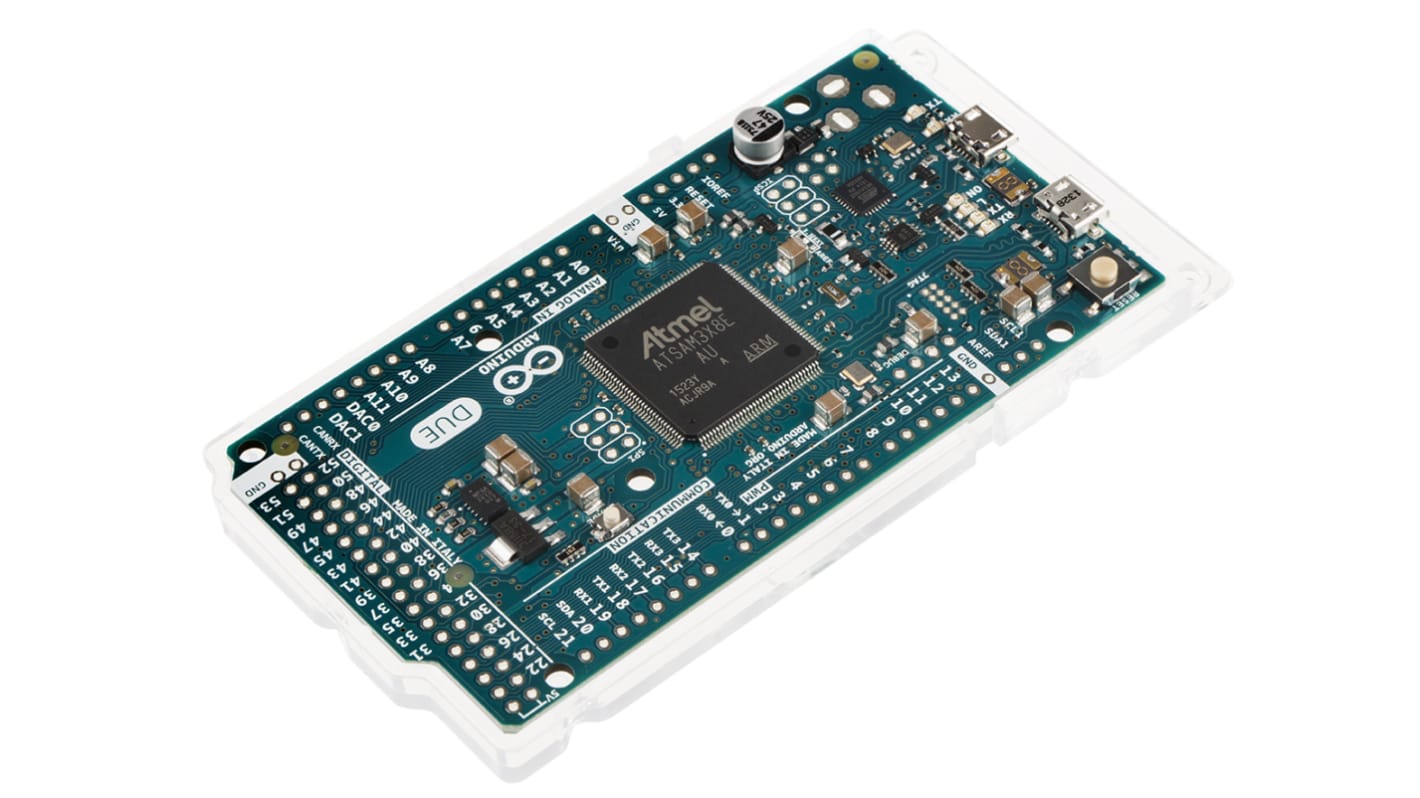
The Arduino Due without headers is a microcontroller board based on the Atmel SAM3X8E ARM Cortex-M3 CPU. It is the first Arduino board based on a 32-bit ARM core microcontroller. It has 54 digital input/output pins (of which 12 can be used as PWM outputs), 12 analogue inputs, 4 UARTs (hardware serial ports), a 84MHz clock, an USB OTG capable connection, 2 DAC (digital to analogue), 2 TWI, power jack, an SPI header, JTAG header, reset button and an erase button. This board contains everything needed to support the microcontroller. You can simply connect it to a computer with a micro-USB cable or power it with an AC-to-DC adapter or battery to get started. The due is compatible with all Arduino shields that work at 3.3V and are compliant with the 1.0 Arduino pinout.
How to get started:
The Arduino Due already has everything on-board to support the MCU. Simply connect it to a PC via microUSB cable or power it via an AC-to-DC adapter or battery. (Please note these are not included)
What else is on-board?
Atmel SAM3X8E Microcontroller
54 x digital I/O pins (12 can be used as PWM outputs)
12 x Analogue inputs
4x UARTS
84 MHz quartz crystal
1 x USB OTG
2 x DAC
2 x TWI
1 x power jack
1 x SPI header
1 x JTAG header
1 x reset button
1 x erase button
Does it work with the Arduino Shields?
Yes, the Due board works with all available Arduino Shields that running at 3.3V and are compliant with the 1.0 Arduino pinout:
- TWI: SDA and SCL pins that are near to the AREF pin.- IOREF: allows an attached shield with the proper configuration to adapt to the voltage provided by the board. This enables shield compatibility with a 3.3V board like the Due and AVR-based boards which operate at 5V.- An unconnected pin, reserved for future use. Arduino ARM Development Boards
Warning
the Arduino Due board runs at 3.3V (which is different to most other Arduino boards). Applying voltages higher than 3.3V to any I/O pin may cause damage.
How to get started:
The Arduino Due already has everything on-board to support the MCU. Simply connect it to a PC via microUSB cable or power it via an AC-to-DC adapter or battery. (Please note these are not included)
What else is on-board?
Atmel SAM3X8E Microcontroller
54 x digital I/O pins (12 can be used as PWM outputs)
12 x Analogue inputs
4x UARTS
84 MHz quartz crystal
1 x USB OTG
2 x DAC
2 x TWI
1 x power jack
1 x SPI header
1 x JTAG header
1 x reset button
1 x erase button
Does it work with the Arduino Shields?
Yes, the Due board works with all available Arduino Shields that running at 3.3V and are compliant with the 1.0 Arduino pinout:
- TWI: SDA and SCL pins that are near to the AREF pin.- IOREF: allows an attached shield with the proper configuration to adapt to the voltage provided by the board. This enables shield compatibility with a 3.3V board like the Due and AVR-based boards which operate at 5V.- An unconnected pin, reserved for future use. Arduino ARM Development Boards
Warning
the Arduino Due board runs at 3.3V (which is different to most other Arduino boards). Applying voltages higher than 3.3V to any I/O pin may cause damage.
Features and Benefits
Input voltage ranges between 7V and 12V
It has flash memory of 512KB and SRAM of 96KB
It has clock speed of 84MHz
SDA and SCL pins that are near to the AREF pin
IOREF allows an attached shield with the proper configuration to adapt to the voltage provided by the board
It has flash memory of 512KB and SRAM of 96KB
It has clock speed of 84MHz
SDA and SCL pins that are near to the AREF pin
IOREF allows an attached shield with the proper configuration to adapt to the voltage provided by the board
Applications
Communication
Embedded system
Embedded system
Certifications
ANSI/ESD S20.20:2014
BS EN 61340-5-1:2007
BS EN 61340-5-1:2007
Related links
- Arduino Arduino Micro Without Header
- Arduino Leonardo without headers
- Arduino Due Development Board
- Arduino BLE Rev2 without Headers
- Arduino Nano ESP32 without Headers
- Hammond Black Arduino Case for use with Arduino DUE Arduino MEGA ADK
- Hammond Blue Arduino Case for use with Arduino DUE Arduino MEGA ADK
- Hammond Light Grey Arduino Case for use with Arduino DUE Arduino MEGA ADK